


From French Polynesia to the Cook Islands
Our Ocean Crossing to Aitutaki
It was time to leave French Polynesia behind and set sail for new adventures. Early in the morning, the bay lay perfectly calm as we lifted the anchor, hoisted the sails, and headed for the pass. We couldn't help but think about the countless Polynesian navigators who had departed through this very opening centuries before us, setting off into the vast Pacific guided by the stars. We slipped past the legendary Motu of the Dead Chiefs, left the turquoise lagoon behind, and pointed Tauha toward the endless blue. Our destination: Aitutaki, Cook Islands, more than 500 nautical miles away.
A Perfect Start
As always, the Pacific welcomed us with a few waves, but nothing too dramatic. We rounded the southern tip of Raiatea, settled onto our course, and watched the island slowly disappear behind us. The first few hours weren't entirely comfortable for me. Even though I had applied a Scopoderm patch the night before, the seasickness still found me. Thankfully, after a few hours, it faded away, and for the first time on Tauha, I could truly enjoy being offshore.
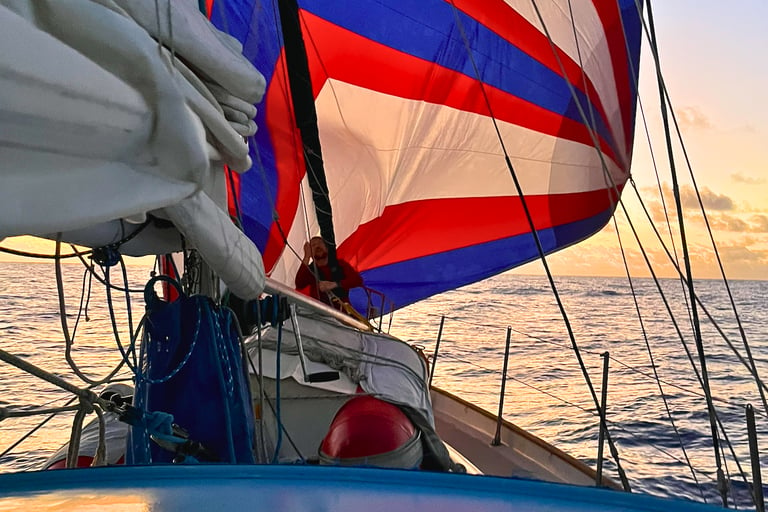
With the wind coming almost directly from behind, we decided it was time to try something new. The spinnaker. For anyone unfamiliar with sailing, a spinnaker is the giant colourful balloon-shaped sail that boats fly downwind. We rolled away the genoa, connected the sheets, and slowly hoisted the enormous sail. The moment it filled with wind was magical. Suddenly Tauha accelerated, gliding across the ocean. Behind us Raiatea became smaller and smaller until it was little more than a silhouette on the horizon. It couldn't have been a better start to our passage.
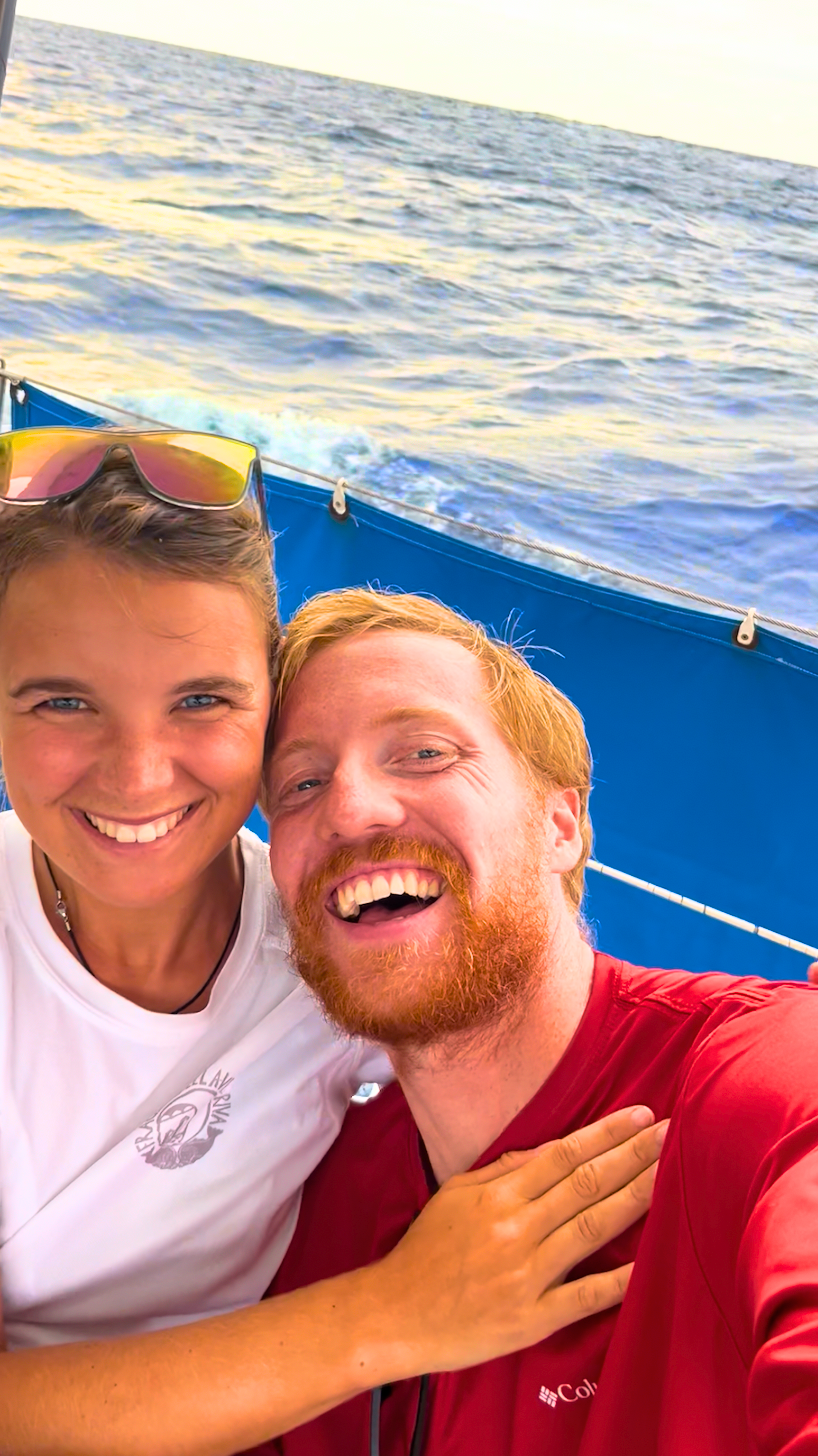
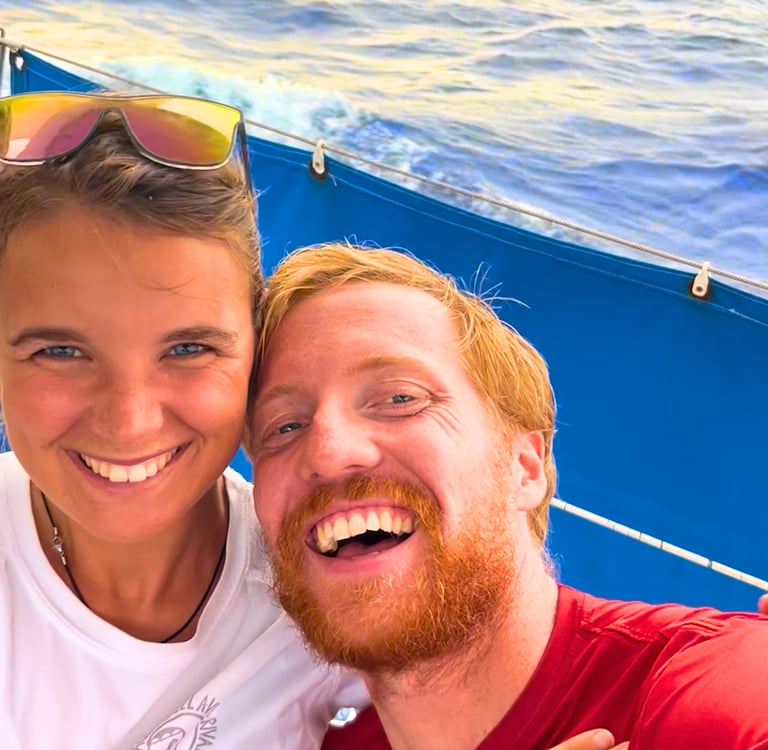
Sailing through the first night
As sunset approached, we decided to take the spinnaker down. We didn't want to leave such a large sail flying overnight in case the wind suddenly increased. Taking it down, however, turned out to be much harder than putting it up.
Neither of us had ever used a spinnaker sock before, a long fabric sleeve that slides over the sail while it's still flying to tame it before lowering it. After a bit of wrestling, plenty of tangled lines, and a few not so nice words, we finally managed to get everything packed away safely.
We live and we learn.
Offshore sailing never really stops. Someone always has to stay awake. We divided the nights into four-hour watches, starting at 8 p.m.
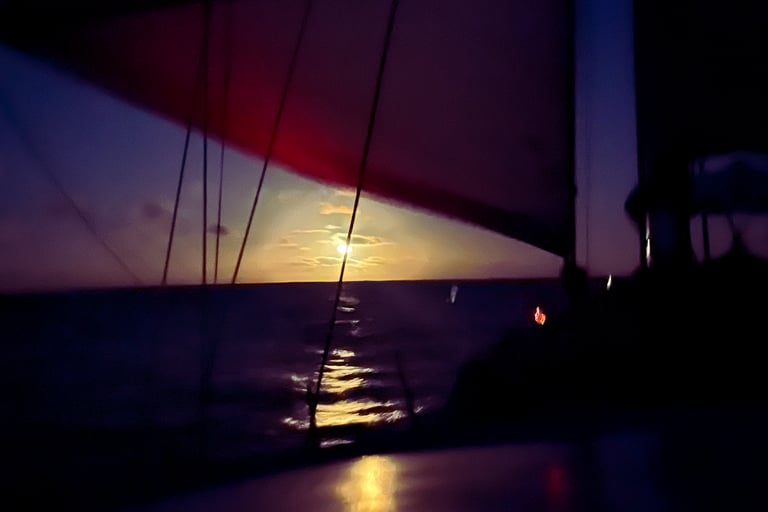
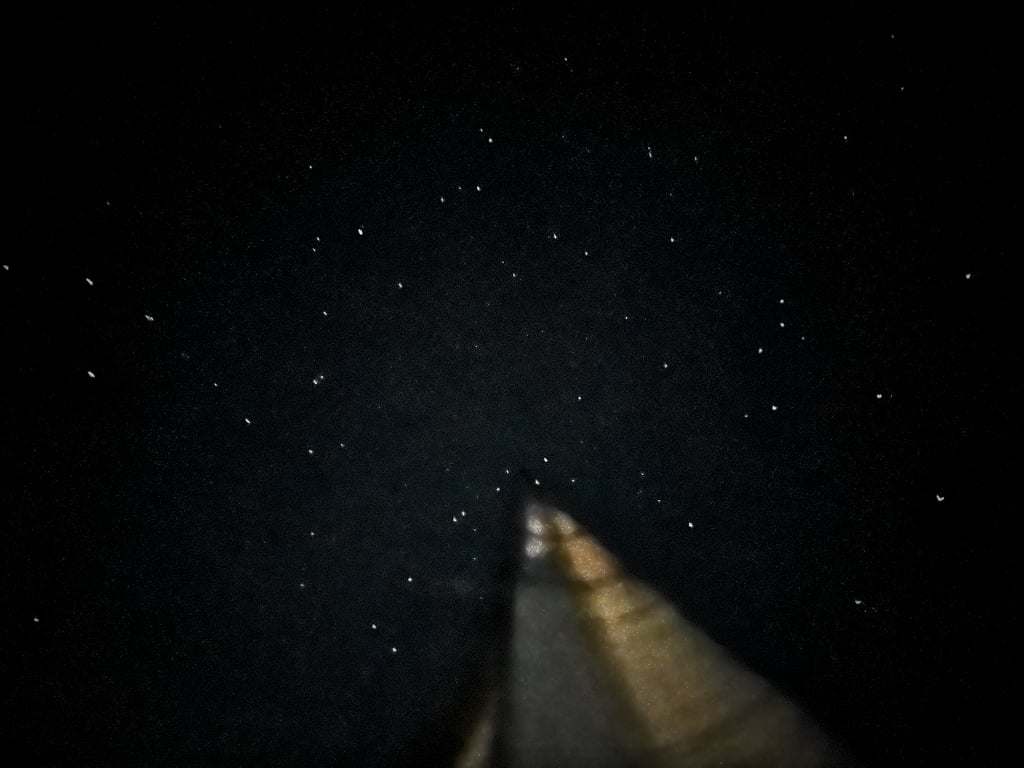
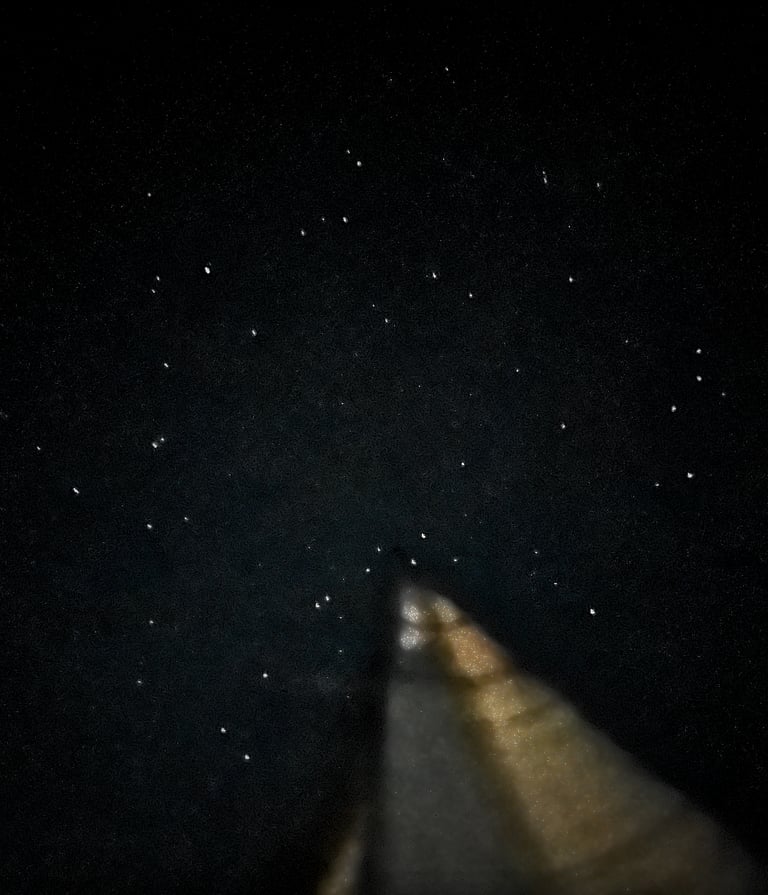
My first watch was wonderfully peaceful. The moon reflected across the water, the stars stretched from horizon to horizon, and Tauha quietly surfed down the waves. Alex's first watch became a little more exciting. Ahead, two bright lights appeared. We kept sailing toward them for quite some time, expecting them to show up on AIS, the Automatic Identification System that allows vessels to identify one another and avoid collisions.
Nothing. No signal. No information. Whether they were fishing boats without AIS or something else entirely, we never found out. Rather than continuing straight toward them, we decided to gybe and alter course. With the wind now stronger, we worked together in the darkness to swing the boom safely across and settle onto our new heading.
When Things Break
The following morning, another gybe didn't go nearly as smoothly. With a loud bang, one of our boom blocks ripped out. It turned out it had only been attached with screws into the boom. The force also damaged part of our traveller system. Not exactly the kind of morning entertainment we had hoped for. Fortunately, after a bit of improvisation, we managed a temporary repair that would safely get us to the next harbour. It wasn't pretty, but it worked.
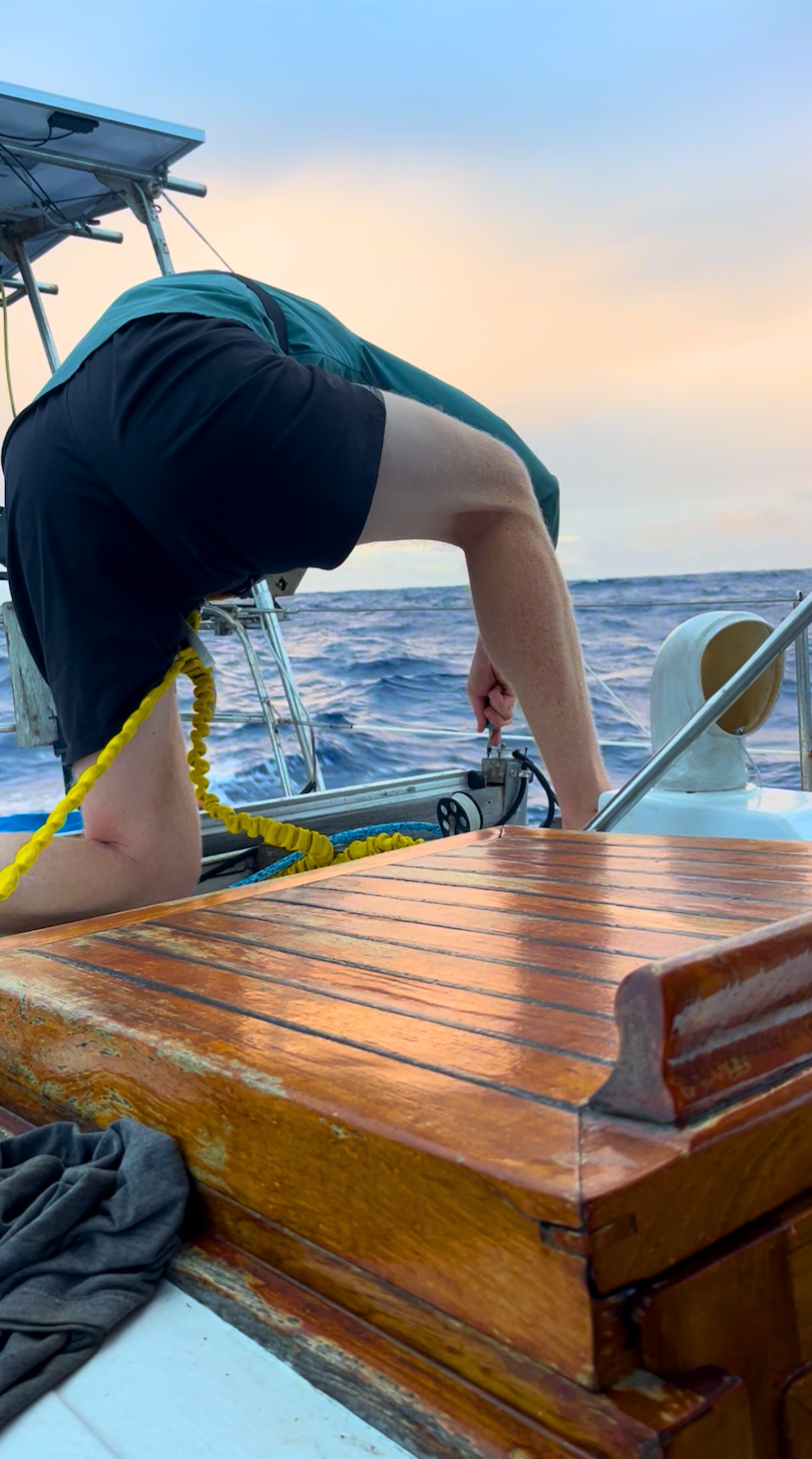
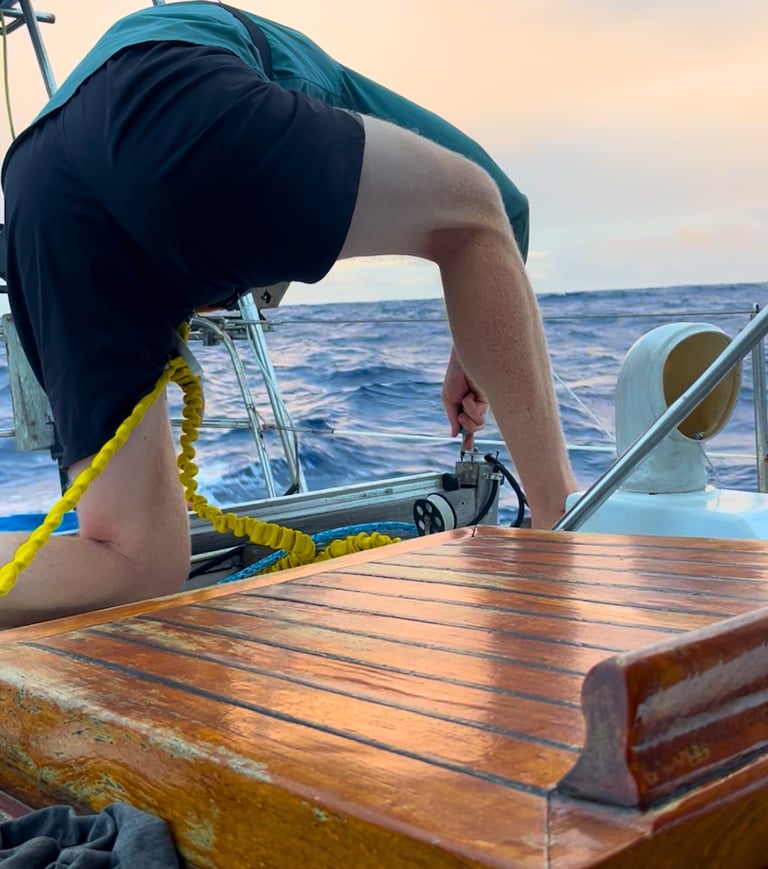
As if that wasn't enough, we soon discovered our autopilot had its own list of complaints. First, it consumed far more electricity than expected, draining our batteries overnight. Then the hydraulic pump started struggling because it was low on fluid. Luckily, we still had hydraulic oil on board and were able to refill it. Finally, the rudder reference sensor, the device that tells the autopilot exactly where the rudder is pointing, began failing almost completely. Sometimes it worked, most of the time it didn't. Which meant...We had to steer manually, almost all the time, for six days. By the end of the passage, our arms definitely knew what they did.
Life at Sea
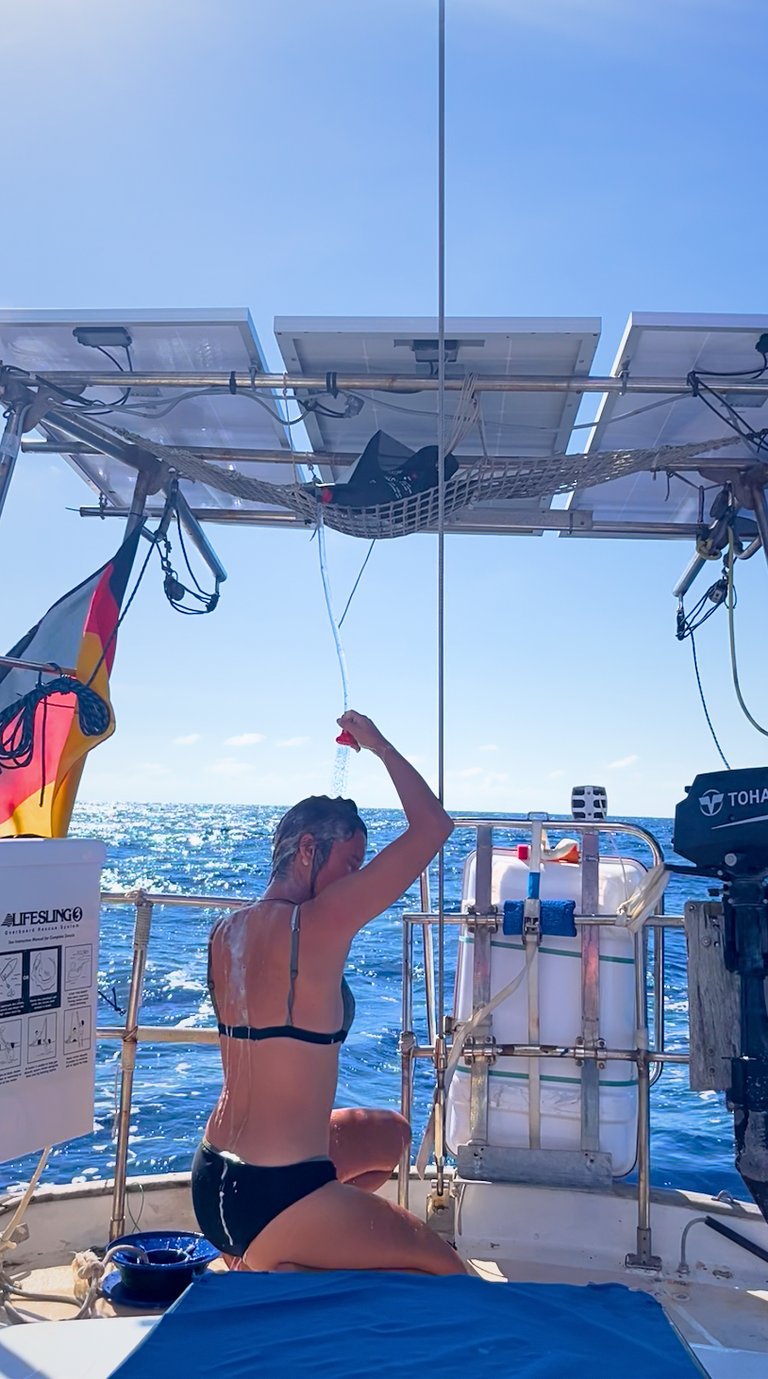
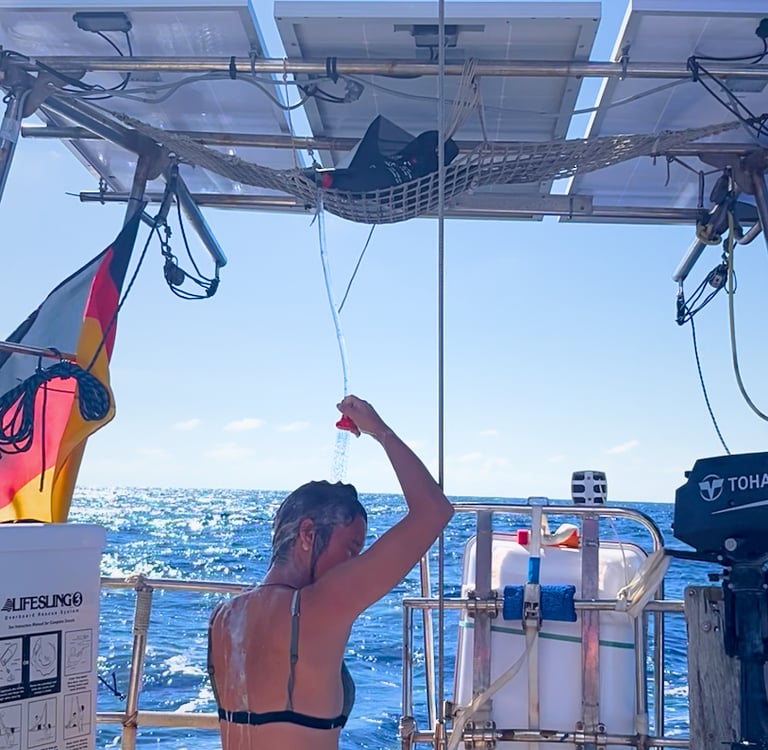
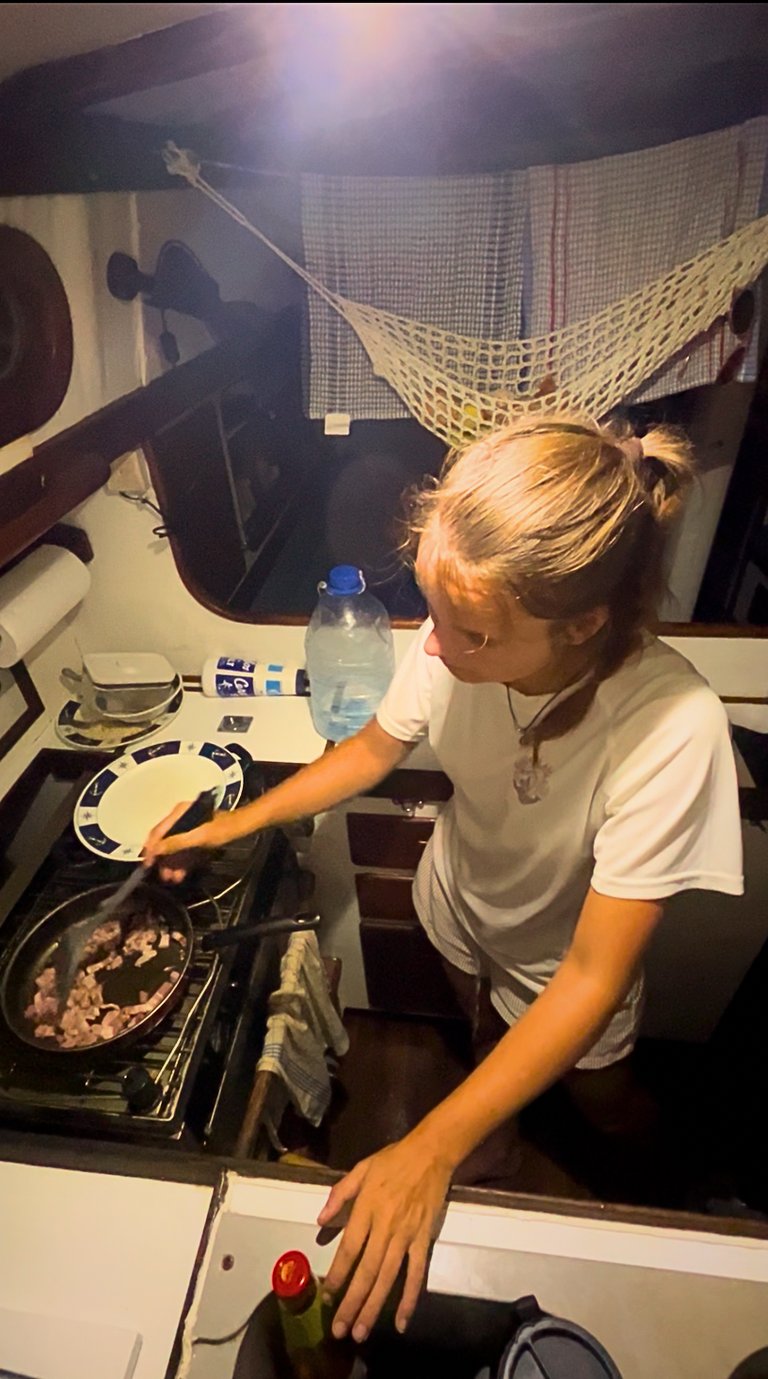
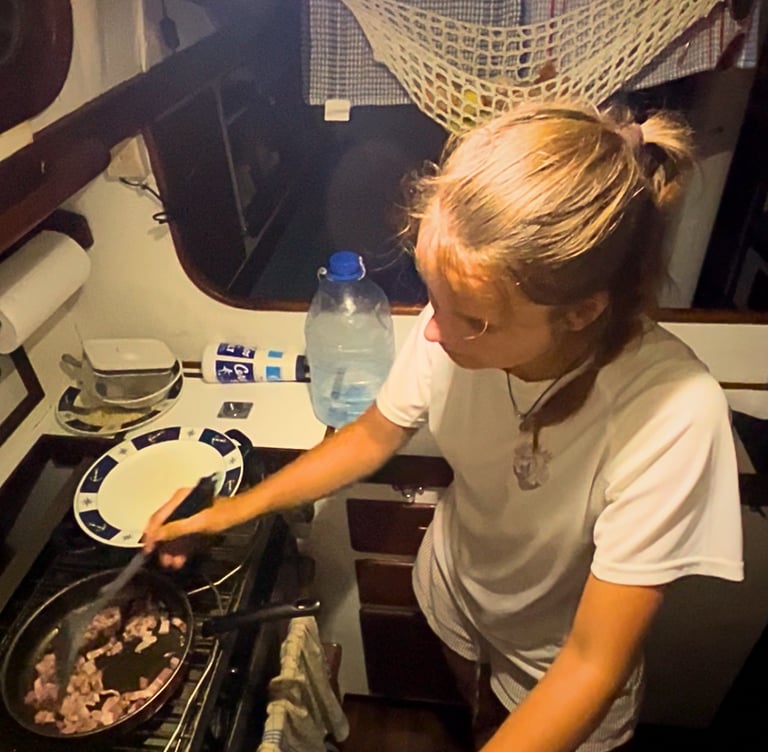
Despite all the challenges, life onboard settled into its own rhythm. Fresh pancakes on Sunday morning. Coffee while watching flying fish skim across the waves. Reading. Cooking. Boat work. Watching seabirds inspect our trolling line in hopes of an easy meal. One afternoon, with no land anywhere in sight, we even enjoyed an ocean shower. We filled our camping shower with fresh water, hung it from the stern, and showered while drifting through the middle of the South Pacific. It felt wonderfully surreal.
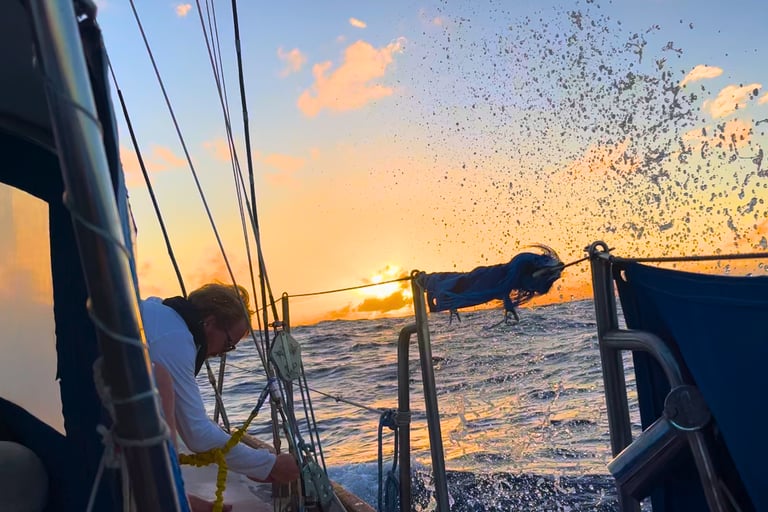
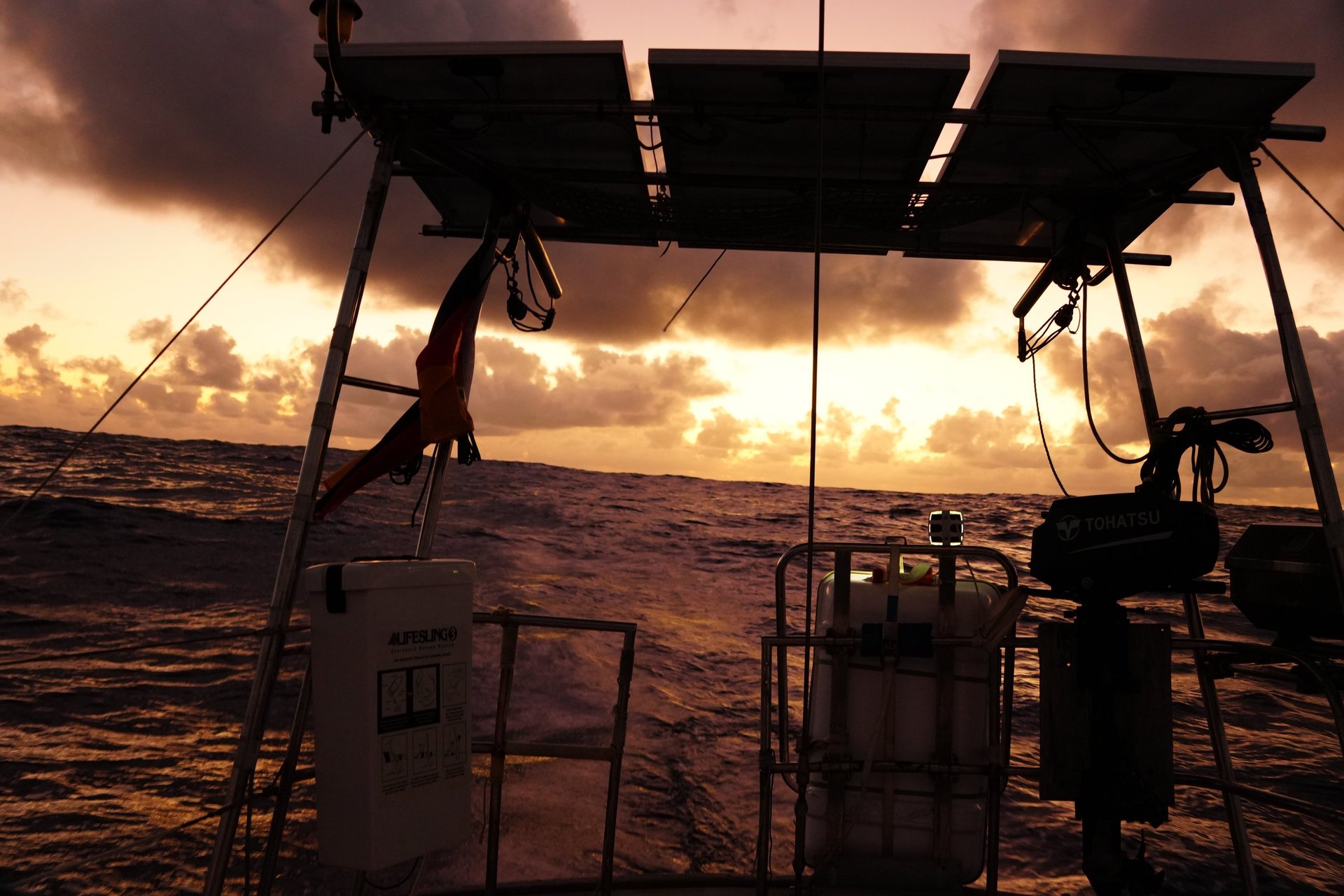
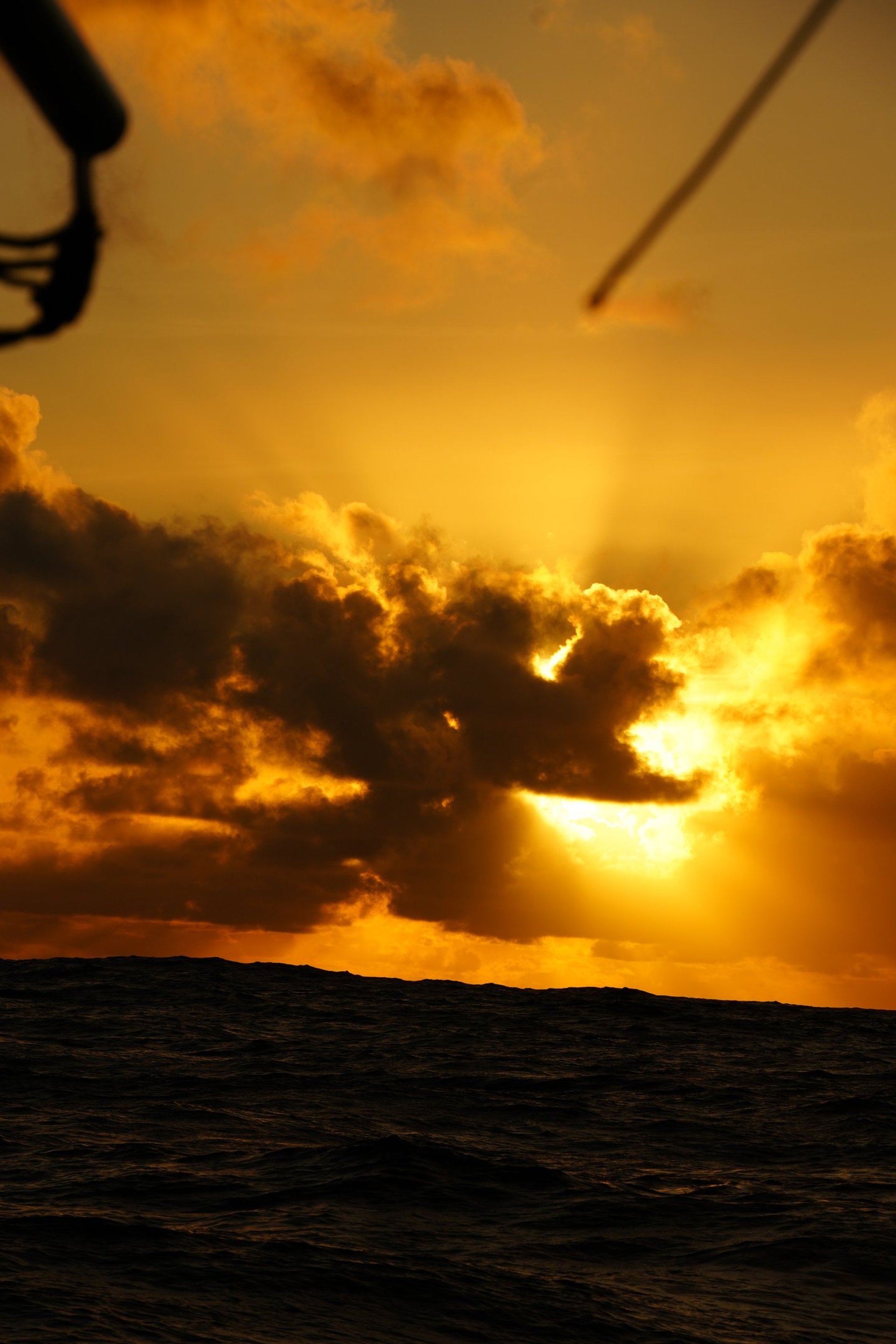
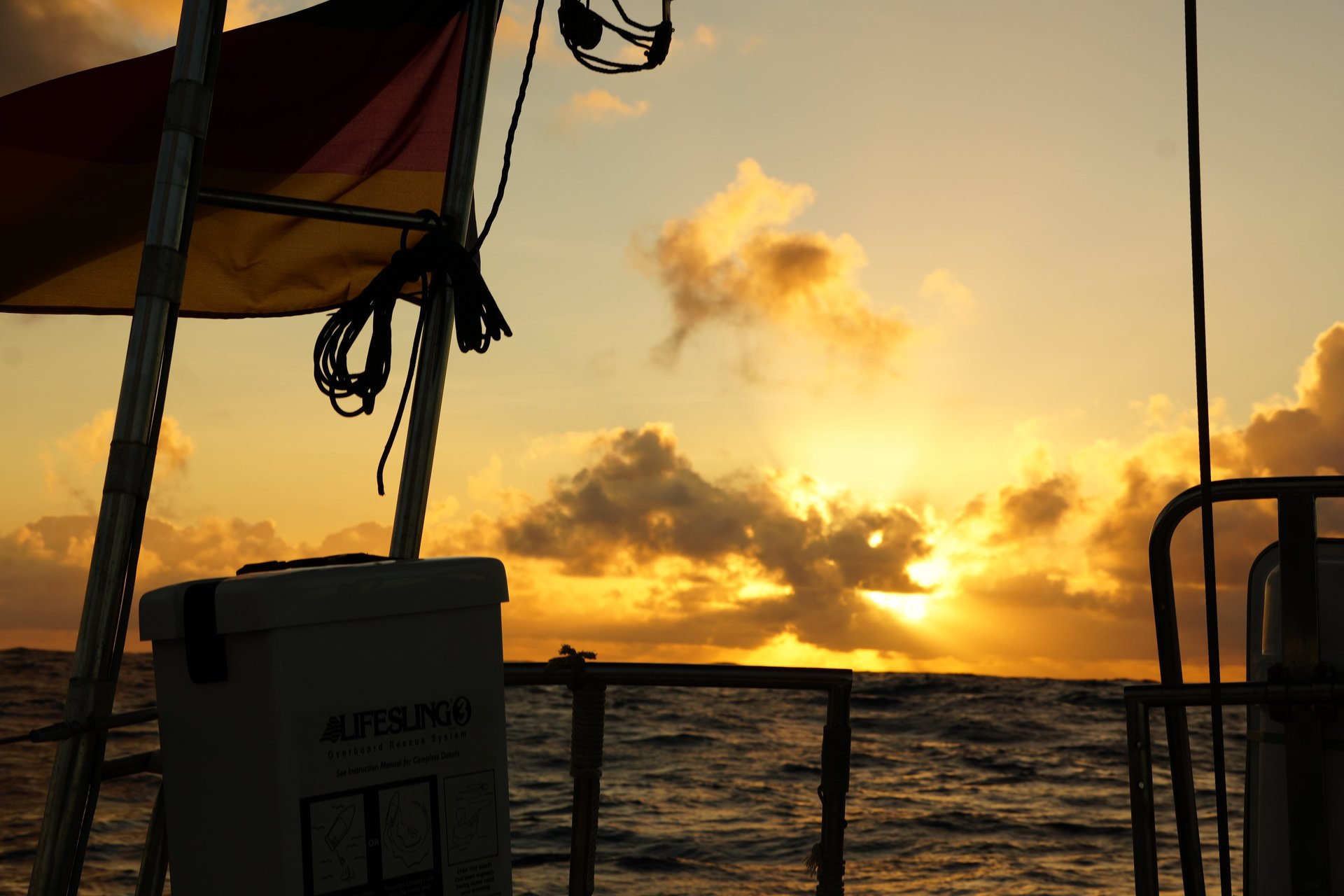
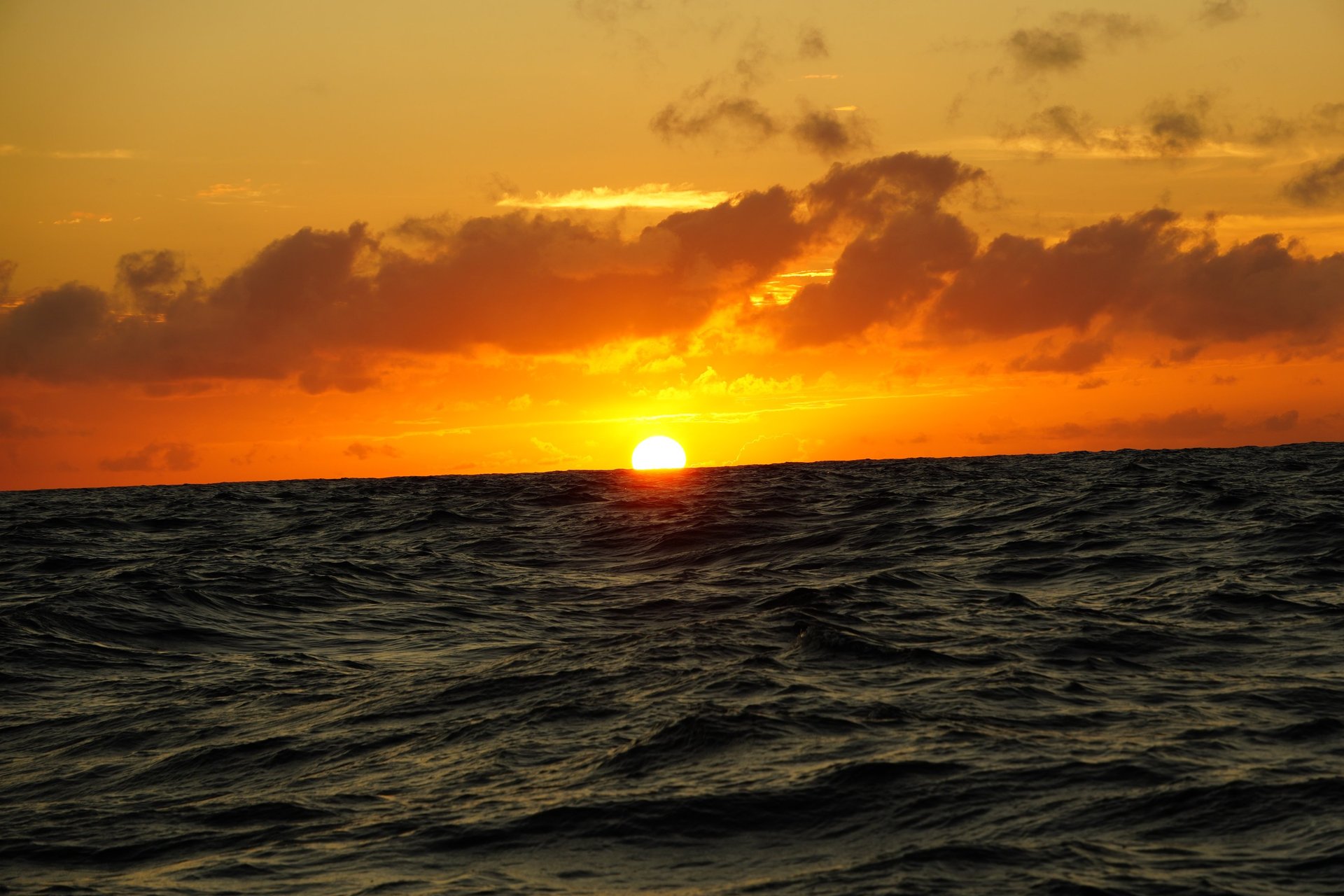
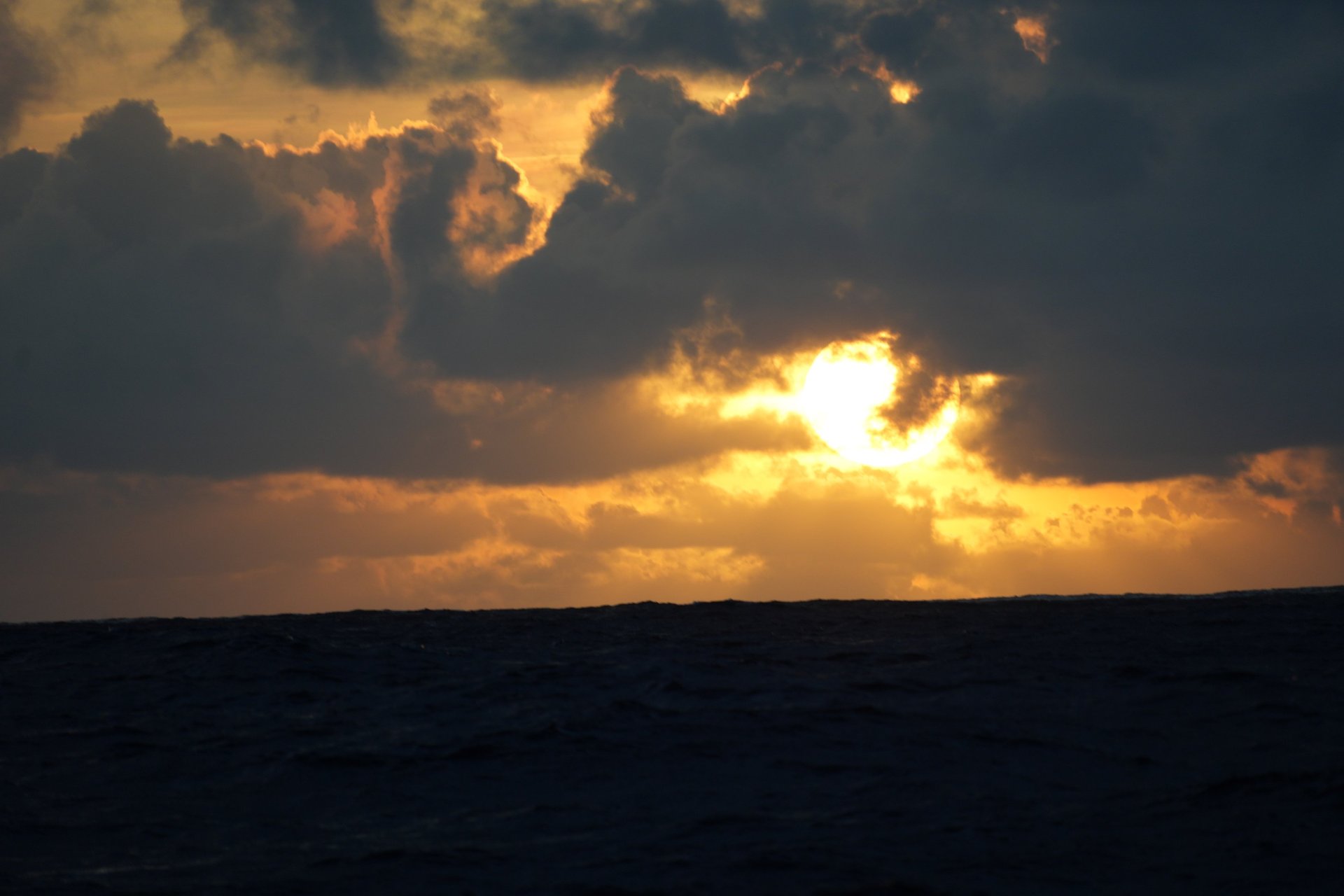
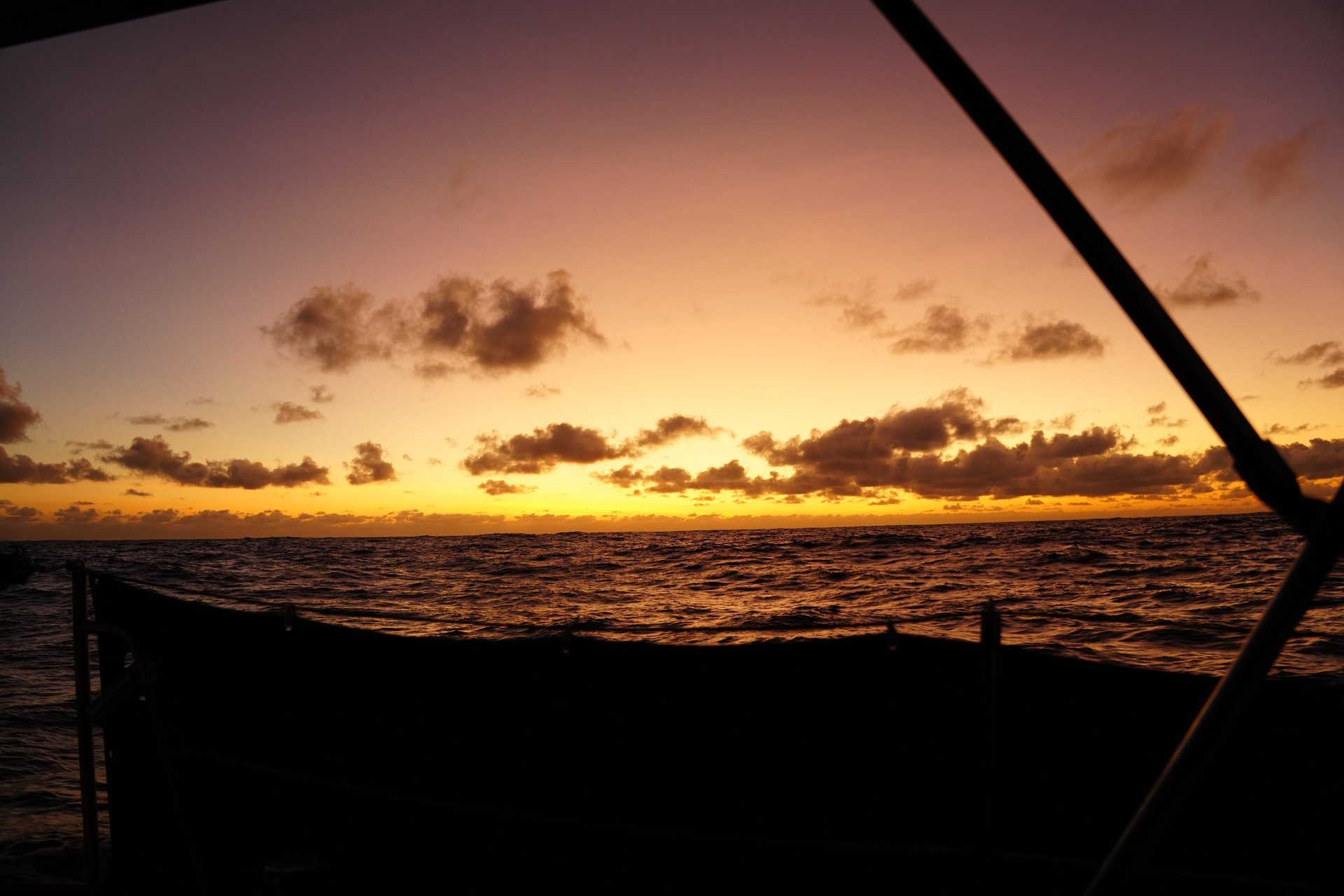
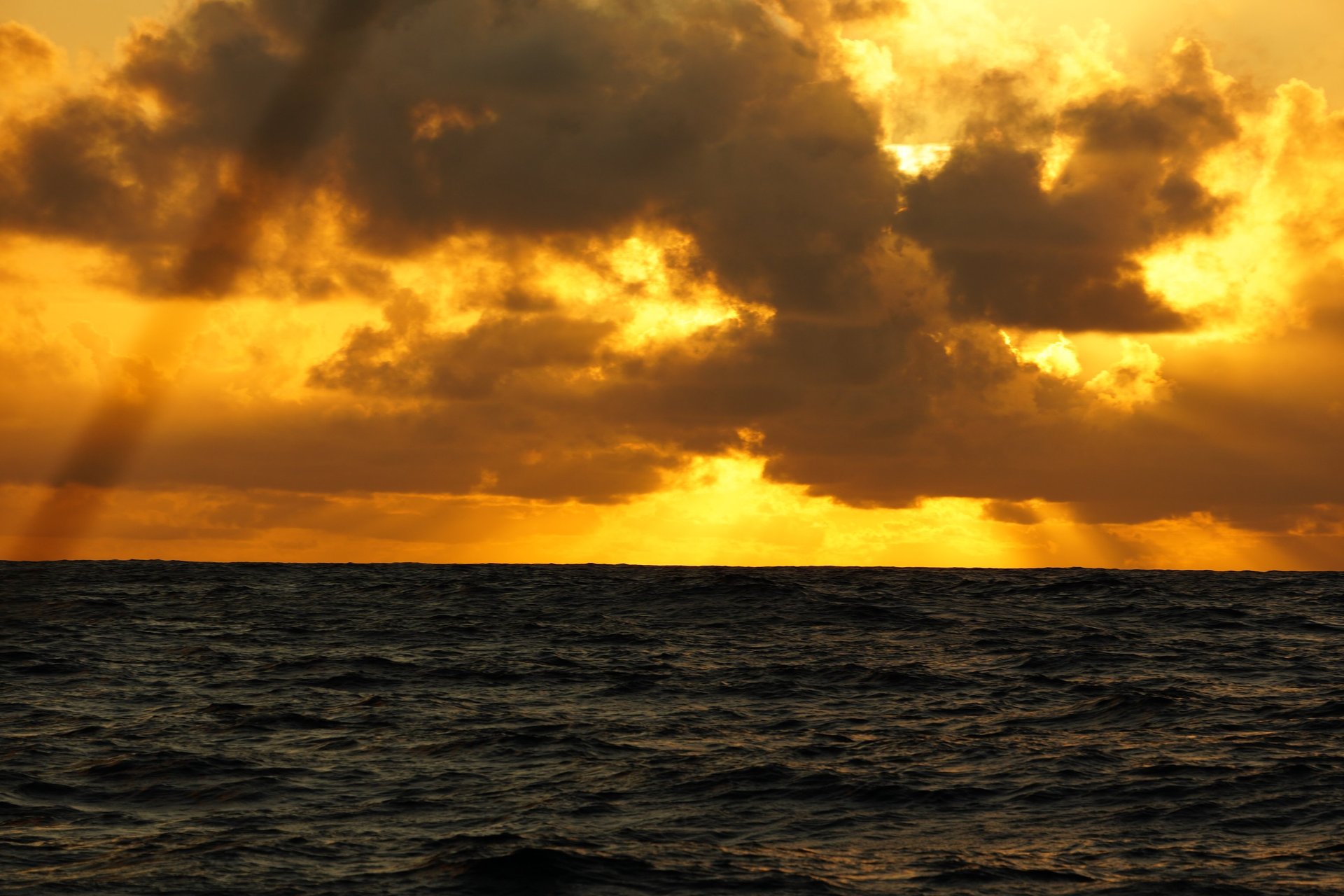
Some evenings the full moon lit the ocean so brightly that we barely needed headlamps. Every sunrise and sunset painted the sky with different colors, reminding us why we love being out here despite all the discomforts.
The Ocean Goes Quiet
On the fourth day, the wind simply disappeared. The sails hung not only lifeless, but were tossed around in the waves. The swell kept rolling.
Without wind to stabilise the boat, we rolled from side to side far more than before. Eventually we gave up, dropped the sails completely, and simply drifted while trying to catch a few hours of sleep.
During passages we don't sleep in our aft cabin. Instead, we move into the saloon, close to the center of the boat where the motion is much gentler. But even there it is loud when things are moving through the boat and you are still getting tossed around quite a bit. Fortunately, the breeze slowly returned the following day.
Land at Last
Early in the the fifth night, the Cook Islands finally appeared on the horizon. Never had a couple of lights in the dark looked so beautiful. By then we were exhausted. Six days of broken sleep, constant motion, endless steering, and repairs had definitely taken their toll. Unfortunately, our timing wasn't ideal. We reached Aitutaki around four o'clock in the morning in complete darkness.
Entering Aitutaki's reef passage at night simply wasn't an option. The entrance is narrow, surrounded by coral, affected by strong current, and just wide enough for boats our size. So we faced two choices: Keep sailing around outside for another four hours...or anchor outside the reef.
Exhaustion made the decision for us.
We dropped the anchor in around 15 metres of water and paid out five times that depth in chain. Behind us, illuminated by the moon, we could clearly see waves breaking across the reef. The coral looked far closer than either of us would have liked. While I tried to get some sleep below, Alex stayed in the cockpit, checking our position repeatedly to make sure the anchor held. Neither of us slept particularly well. When daylight finally arrived, the reef somehow looked even closer than it had in the darkness.
Threading the Needle
As we prepared to enter the harbour, another fishing boat headed through the reef pass ahead of us. We watched as it was thrown from side to side by the steep waves while trying to line itself up with the narrow entrance. Seeing that definitely didn't make us feel any more relaxed.
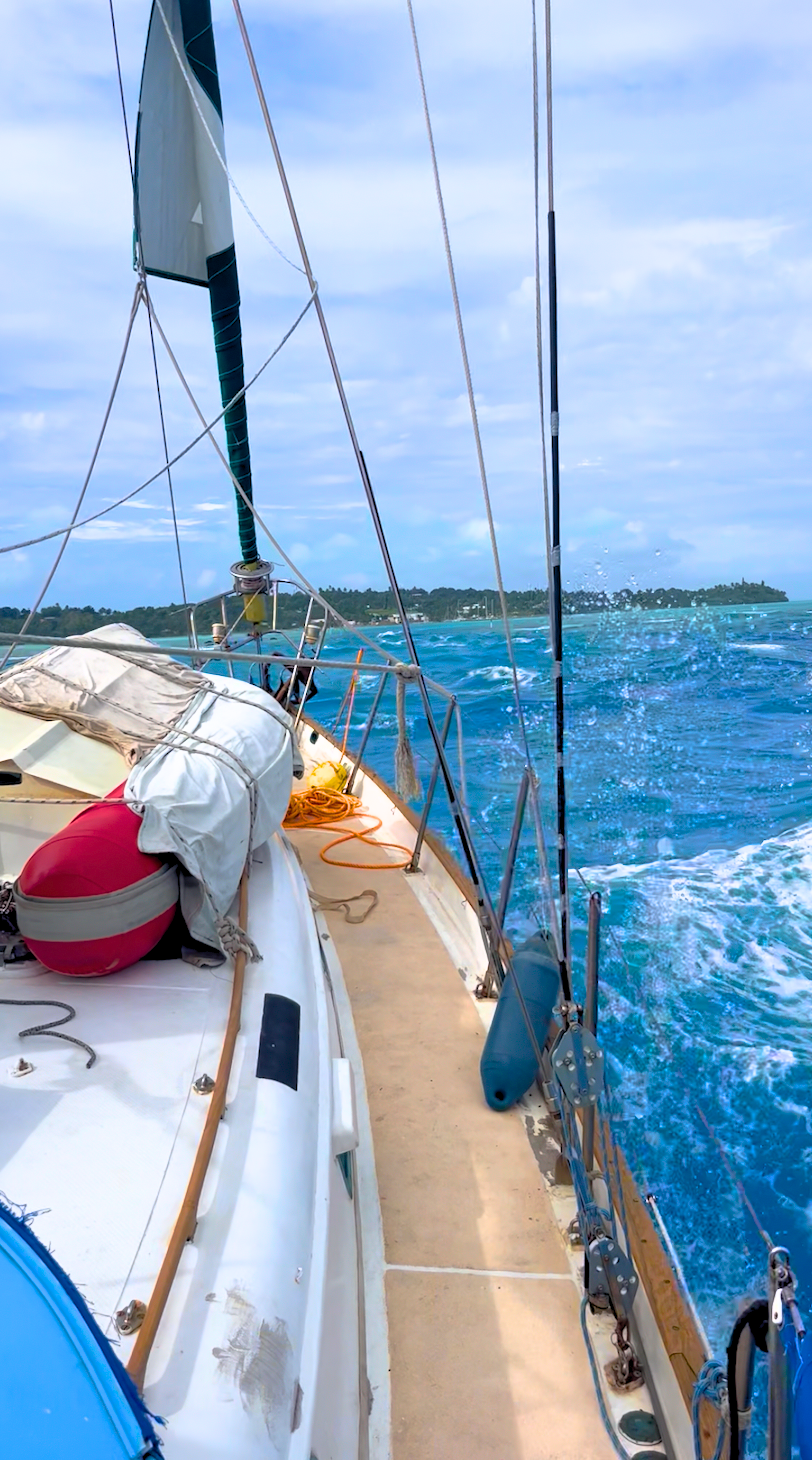
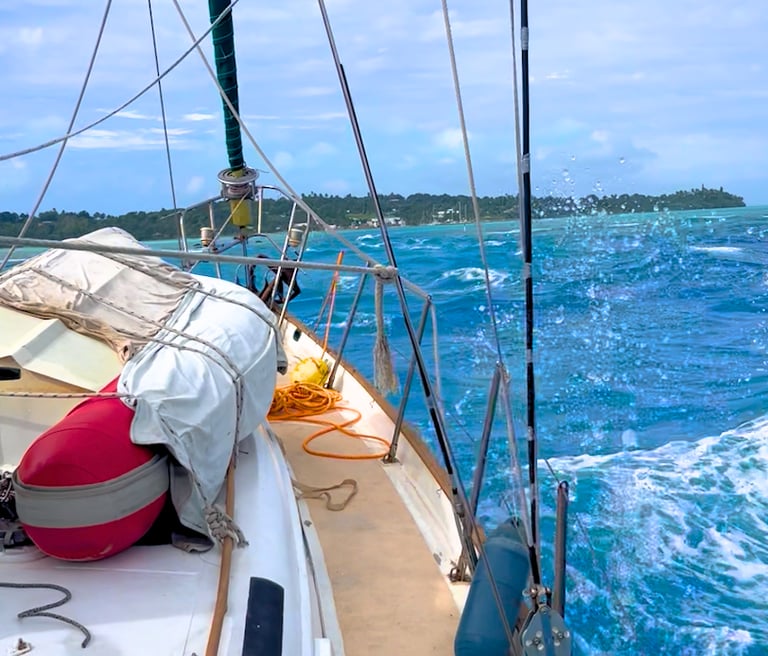
When everything was ready, we radioed the harbour, received clearance to enter, and slowly lifted the anchor. I took the helm while Alex stood beside me, acting as a second pair of eyes. As we approached the reef, the waves became steeper and started rolling the boat heavily from side to side, making it difficult to hold a straight course. At the same time, a strong current was trying to push us off line.
"More to port... now back to starboard... hold it... keep coming..."
I constantly adjusted the wheel while Alex called out directions, both of us focused on hitting the narrow opening at exactly the right angle.
For a few tense moments, it felt as if the ocean had a mind of its own. Then, finally, we slipped between the coral walls. The breaking waves stayed behind us, the water flattened almost instantly, and the boat settled down. We looked at each other with huge smiles and still shaking legs. The hardest part was over, we had made it safely through Aitutaki's reef passage.
One Final Challenge
Making it safely through the reef passage wasn't the end of the challenge.
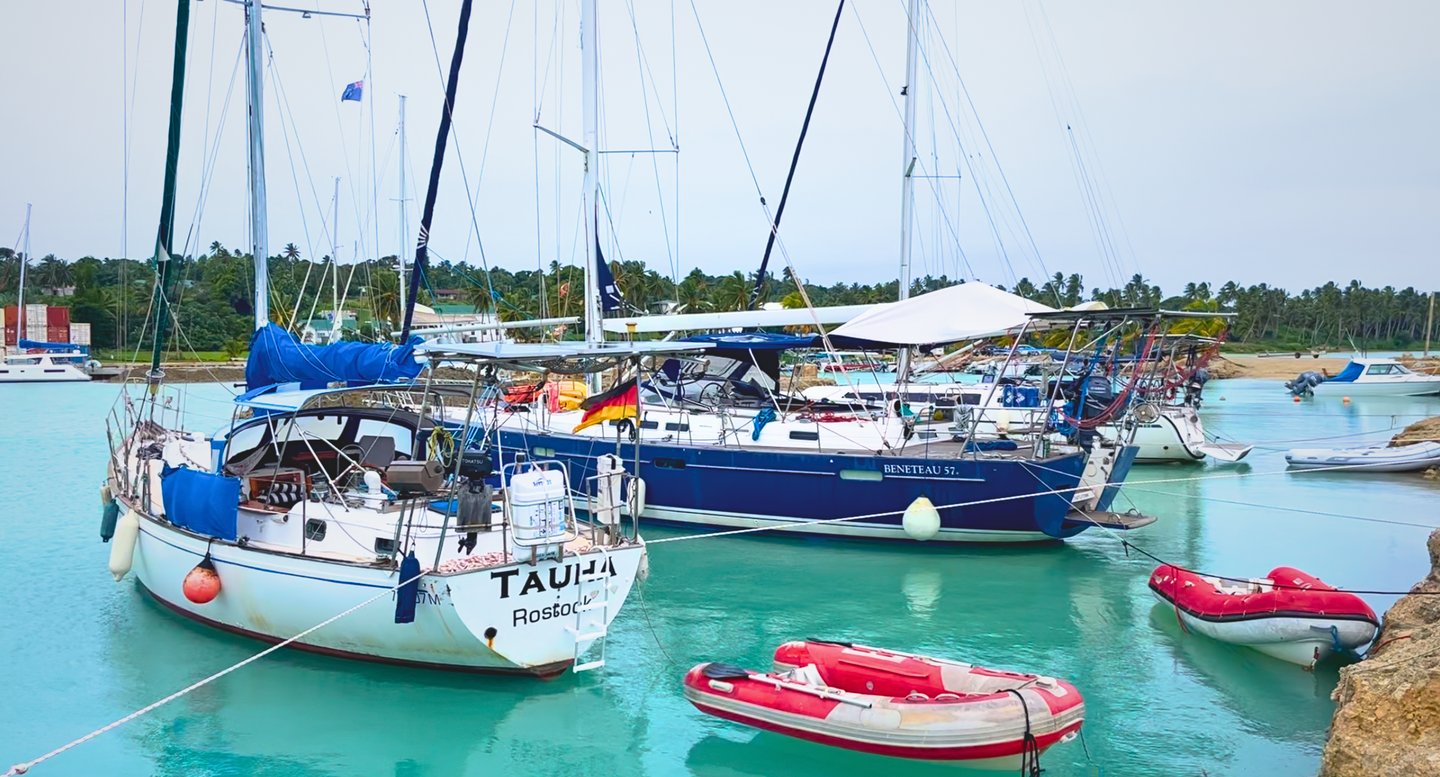
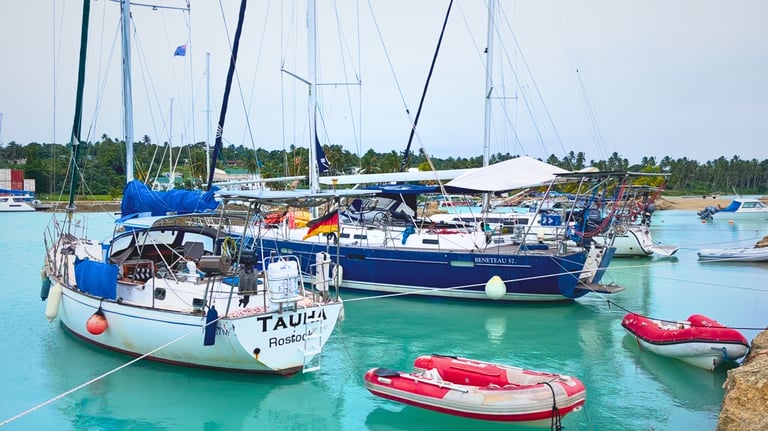
The harbour is small, and there was only one space left for us, between two other sailboats. The only way to moor there was using Mediterranean mooring, where you first drop your anchor, then reverse toward shore while people on land take your stern lines and secure them to large concrete blocks. It sounds straightforward. In reality, it's tricky.
Our boat has a strong prop walk, meaning that whenever we reverse, the stern immediately wants to swing to port. Without bow thrusters, keeping the boat lined up while backing into a tight space between two neighbouring yachts takes a lot of concentration.
As I carefully reversed, Alex handled the anchor and prepared the stern lines. With very little room to maneuver, we slowly worked our way into the berth. Thankfully, several sailors who had been watching came over to help, taking our lines and guiding us the last few metres.
After plenty of communication, a few corrections (meaning driving back out and trying it again), and a healthy dose of adrenaline, Tauha was finally secured in her new home.
Welcome to the Cook Islands
With Tauha finally safely tied up, it was time to officially enter the Cook Islands. Not long after we had finished tidying up the boat, the first official arrived. A health officer came aboard to make sure nobody was sick and that we hadn't brought any diseases with us. After a few friendly questions and a quick look around, we received the all-clear.
Next, we walked over to the customs office carrying our passports and a stack of paperwork. We filled out the arrival forms, answered the usual questions about where we had come from and where we were heading next, and finally received the satisfying sound of another passport stamp. We had officially arrived in the Cook Islands.
There was one more inspection still to come. A couple of days later, the biosecurity officer visited the boat. His job was to check that we weren't bringing any prohibited plants, fruits, vegetables, or other food items into the country that could introduce pests or diseases to the islands. He looked through our fresh produce, asked a few questions, collected our rubbish, and then spotted them. Our limes. As it turns out, fresh citrus fruit isn't allowed to import to the Cook Islands, so after 500NM on sea they left us.
More than 500 nautical miles. Six days at sea. Broken equipment. Night watches. Ocean showers. Countless waves. Beautiful sunsets. A full moon over the Pacific. And finally, one tiny harbour inside one of the most beautiful lagoons in the world. As we sat in the calm water that evening, surrounded by palm trees instead of ocean swells, it finally sank in. We had sailed all the way from French Polynesia to the Cook Islands.
And a whole new adventure was just beginning.
If you’d like to read more, follow our journey, and support what we do, don’t forget to subscribe to our newsletter or follow us on social media. Every bit of encouragement helps keep the adventure going and we’d love to have you aboard!